Chess tutor, writer, organiser and player. Ex-bridge player, cryptic crossword solver and ex-compiler. Music lover. Family and local historian. Website programmer and promoter, editor, proofreader.
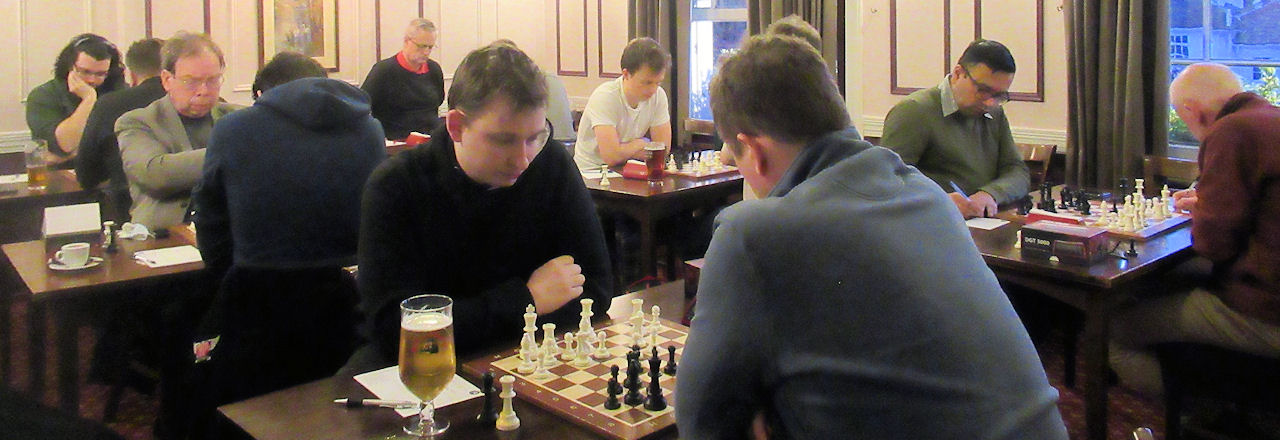
Our last Thames Valley League match of the season pitched our A team against second placed Hammersmith A. With nothing at stake we hoped they might not be at full strength, but that wasn’t the case. We were outrated heavily on all except the top board.
It was great to welcome Nick, an RJCC star 45 years or so ago, back to competitive chess.
Given the disparity in ratings a heavy defeat was to be expected, but Alastair scored an excellent win with t he Black pieces against a much more recent RJCC star.
Here’s the game: click on any move for a pop-up window.
Thanks to captain Maks and to all who played in this match, and indeed all our matches this season.
Still to come we have a London League match, again against Hammersmith, which was scheduled for 2 June, but has been postponed due to the tube strike and will now take place on Tuesday 7 July.
My latest Minor Piece tells the story of a group of chess problemists from Broadmoor, in the terminology of the times a criminal lunatic asylum, in the 1920s.
You’ll find several problems there for you to solve: here’s another one, composed by the rather mysterious LC Hallam.
#2 Laurence Cyril Hallam The Referee 29-04-1929
Although positions like this would never occur in a game, many chess teachers believe that solving problems of this nature is a great way of improving your tactical skills, powers of calculation, creativity and imagination.
When they were learning chess the Polgar sisters, for example, solved many hundreds of composed problems of this nature.
Can you find the solution to this one? It’s White to play and mate in 2 moves against any Black defence.
Chess by correspondence, in the middle decades of the last century, was a very popular activity.
It’s still played occasionally, by email rather than post of course, and there’s no restriction concerning engine usage. Consequently, almost all games, with your Stockfish taking on my Stockfish, result in draws. But there are those who enjoy this, and the fascinating positions which might arise.
This position is taken from a game posted on Facebook today by US correspondence player Frederick Rhine. Frederick was playing White against Joe G Tanti.
It’s White’s move. How should play continue? How would you assess this position?
It’s too hot to do anything else today, so have a fun Bank Holiday analysing this position.
What will probably be the final Chess Heroes book (although I have a few ideas for future booklets) is now available to download or read online here.
Chess Heroes: Games Book 2 presents 34 games, including examples of play from all World Champions and some of the most famous encounters in chess history.
Your job in each game is to take the winning side and try to guess the moves. I believe this type of activity is one of the best ways to improve your chess.
This is a position from Game 32: Bai Jinshi – Ding Liren. Here’s the question – and the answer, taken from the book.
Choose a move for Black.
20… Rd4
Score 10 points for this move, bringing the rook into play. As it happens, h5 is equally good so I’ll give you 10 points assuming you’d find Rd4 next move. 5 points for Rd6, the next best option.
Bonus Question 4: What would you play now if White played 21. exd4?
Answer: An easy 5 points for Nxd4, forking king and queen.
As a rough guide, I’d say that most of the games in this book are most suitable for players round about 1500-1750 strength (Game 5, for instance, would be great for 1000 strength players).
If you’re a beginner, start with the Chess for Heroes book. If you’re, say, 500-1000 strength, read the Checkmates, Tactics, Openings and Endings books in parallel.
If you’re above 1000 strength, the first Puzzles and Games books will be great for you. When you’ve completed these books, move on to the second Puzzles and Games books.
You can download them here or, if you want hard copies (the second Puzzles and Games books are not yet published) buy them either on Amazon or directly from the author.
The final Chess Heroes book, Chess Heroes Games Book 2, will be available in pdf format within the next day or two. I’m sure you’re all looking forward to it.
By way of a taster, here’s a position from one of the featured games.
Black to play: how would you continue here?
I’ll tell you more about both the position and the book later in the week.
Two vital relegation matches this week, with mixed fortunes for our teams.
On Wednesday we faced Streatham 1 in the London League, hoping for at least a draw.
A great result against a higher rated team, with excellent wins from Mike, Caspar and John, the last two against much higher rated opponents. It could have been even better as well, with Iain and Alastair both erring in time trouble. Alastair also missed a win in the opening.
Here’s the current league table. We’re not mathematically safe yet, but Lewisham’s last two matches are against Cavendish and Wood Green.
The following evening our TVA team faced Kingston A, perhaps the strongest amateur club team in Britain, who, following their usual maximalist policy, fielded an exceptionally strong team with an IM down on board 4.
The whitewash wasn’t unexpected. We had chances in several games but didn’t take them. Alastair and Ian were both level until committing immediately fatal oversights.
Congratulations to Kingston, who may well be, at least by some measures, the best chess club in the country at the moment. They’re covering all bases, finishing 2nd (as CSC/Kingston) in the 4NCL, fielding very strong teams in local leagues, running internal competitions, doing a lot of community outreach, and they will be starting a junior club, which I’m sure will be very successful, later in the year.
Even a point in this match might have made a big difference, as you’ll see from the current league table.
We’re assuming only one team will be relegated. Wimbledon A, who won Division 2 will want to be promoted, but we understand that Maidenhead B, who have finished 2nd, will probably decline promotion.
Ealing A travel to Kingston B on Monday, needing a win to overtake both Surbiton and ourselves on game points. If they win, we’ll need to draw our last match against Hammersmith on 28 May to be certain of staying up. A 2½-3½ defeat will leave us level with Surbiton and facing a play-off for survival.
Thanks, as always, to all who played in this week’s matches, especially Caspar, John and Alastair who played in both of them.
On Monday I asked you how White should continue in this position (Sasikiran – Eren Prague 2026).
There was a lot of online discussion on this one, but the correct solution was eventually discovered. Well done everyone (especially David H and Adrian W), and thanks for participating.
The game continued 1. d7! Qd6 2. Qe6! Rb1+ 3. Kh2 Rd1 4. Nxf6+ Kh8 5. d8Q+ Qxd8 6. Qxf7 and Black resigned.
You get full credit for finding the first two moves here.
I took this position from the latest issue of CHESS, which publishes 24 puzzles of varying degrees of difficulty every month. They published the position from two moves earlier, but the second move in their solution wasn’t significantly better than several alternatives, so I started from here.
If you’re serious about chess improvement you should be spending time every week, preferably every day, solving puzzles of this nature, either online or from books and magazines.
Just the one match to report as the season reaches its end.
Our TVB team’s last match was against Wimbledon B, who were unfortunately only able to field four players.
Here’s what happened.
At one point a draw looked very likely. Victor had no trouble disposing of his low-rated opponent. Adrian C got into trouble in the opening, and, although he won material, his lack of development made his position too hard to defend.
At that point, the last time I looked at the games, Tom L was a piece for a pawn down in the ending, although, with not so many pawns remaining there were technical difficulties. Manuel’s opponent had an extra advanced passed h-pawn, again with queens off the board, which looked very strong.
The next thing I knew, Manuel emerged to tell me he’d won his game: he thought he was always holding and his opponent, under time pressure, blundered before his flag fell in what was by then a losing position. Tom L had managed to defend his lost ending.
So we emerged with a victory which wasn’t as convincing as it looked on paper.
It was great to be able to give a club debut to Manuel and a team debut to Adrian C.