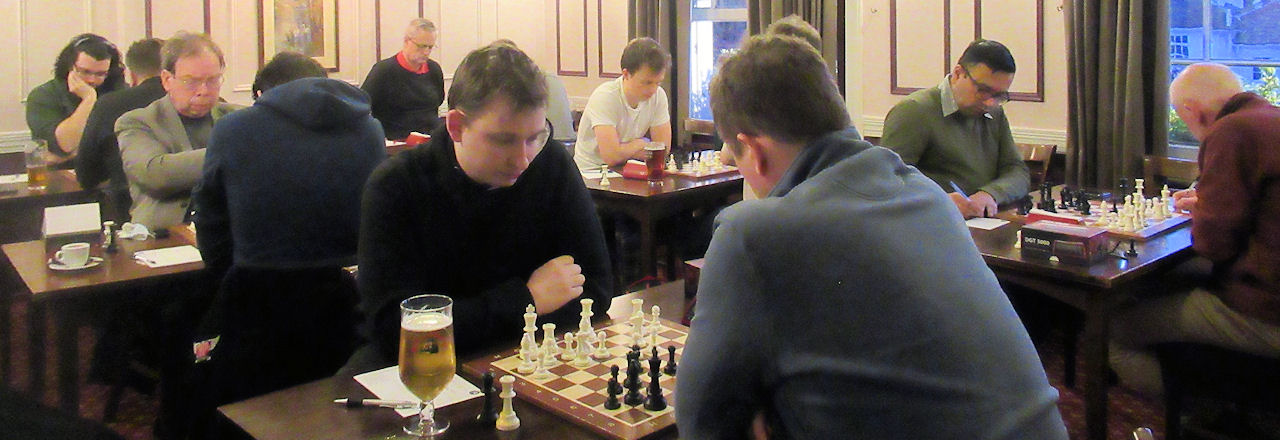
Match report:
| Board | Rating | Surbiton A | V | Richmond & Twickenham A | Rating |
|---|---|---|---|---|---|
| 1 | 2140 | Briscoe, ChrisN | 0 – 1 | G Wall, Gavin | 2333 |
| 2 | 2058 | Chaudhry, AltafB | ½ – ½ | B Baker, Chris B | 1970 |
| 3 | 2057 | Tambini, JasperG | ½ – ½ | G Gajowniczek, Maks | 1895 |
| 4 | 2038 | Scott, David AG | 1 – 0 | B Barlow, Bertrand A | 1879 |
| 5 | 2029 | Way, Julian MG | 1 – 0 | L James, Richard | 1934 |
| 6 | 1978 | Bayly, LiamB | 1 – 0 | G Low, Sampson E.D. | 1870 |
| Total | 12300 | 4 – 2 | 11881 |
Essentially the only excellent result from our side was Gavin’s game. Overall our top 3 boards did well, whereas our bottom 3 struggled a bit. This is not surprising as the rating difference was better for us there as well as there being an extra game with white.
The most exciting game by far was also Gavin’s game. It started with an eccentric opening d4 h5?!, c4 e5!? then the pawn was captured and Bb4+ was played by black.

It evolved into quite a dicey game, where both sides had far advanced pawns on the kingside and Gavin even had an impressive deflection sacrifice at one point, offering a Queen on c2 which if taken would have allowed a pawn on g7 to go to g8 and promote with check. The tactical fireworks ended up resulting in a 2 bishop and rook vs 2 rook imbalance for Gavin. Not really sure if I have the position correct, but it looked something like above (right hand side), soon before queens came off. The pawn on g3 was captured by a bishop one of the remaining passed pawns was enough to convert the game to a win for white.
On board 2 Chris played well. His opponent got practically nothing from the opening, opting to go for an untheoretical double fianchetto, whereas Chris responded in principled fashion with a Dutch (f5) with queen-side fianchetto setup. The game looked quite quiet with a lot of piece trades happening. Chris offered draw with a slightly better pawn structure as black and level material and rook and knight for both sides. His opponent quickly accepted, then proceeded to show a highly risky line showing he could temporally sacrifice a pawn to win two pawns, but allow Chris a dangerous passed pawn in the process (while also probably misplacing his own pieces). He presented this as a ‘lesson’ which seemed at least to me a little humorous.
My own game on board 3 was also quite quiet. I played something a bit new to me, a delayed catalan or ‘pseudo-catalan’ and my opponent kept the position closed for the most part. It ended also in a draw offer when all minor pieces were exchanged as well as both central pawns.
It did have one interesting moment although I did not pick up on the idea during the game.

I had previously played the slightly odd looking Ba3 and after cxd4, Bxe7 Qxe7 we arrive in the above position.
My question to you is what would you play here?
Qxd4 looks the be the only sensible move, However there is a sharp possibility of cxd5 which would have forced my opponent to play accurately.
So after 12. cxd5!?
a) ..dxc3?? (Black falls for the trap), d6 Qe8, Bxb7 (White is winning)
b1) .. Qb4!, Ne4 Nxe4, Bxe4 exd5, Bd3 (+0.2 for White)
b2) ..Qb4!, Ne4 Nxd5, a3 Qe7!, Qxd4 (equal)
c) ..exd5, Qxd4 (a bit better for White, playing against the IQP)
d) ..Rd8, Qxd4 Nxd5 (best), Rfd1 (pin against rook on d8) Na6! (only sensible way to unpin) (+0.3 for White after Nxd5)
e) ..Na6!? d6 Qxd6, Bxb7 Qxe5, Bxa8 Rxa8, Na4 (+0.4 for White)
As for our bottom 3 boards.
On board 4 Bertie played a Tarrasch defence, accepting an isolated queen’s pawn, although it got there via some non- Queens Gambit’s move order. It looked sort of OK for Bertie as it was level material and his opponent also had an isolated a-pawn that could become weak, but as the game progressed Bertie’s pawn structure got a bit compromised after a piece trade on e6. This then allowed his opponent to swarm in with his pieces through the holes in his position and get a very good and winning ending. The only slight criticism I have is Bertie perhaps could have used a bit more clock time to try and defend as well as possible, but perhaps it was more about putting time pressure on his opponent, I am not sure.
Board 5 Richard played an English opening and his opponent responded with e5 ‘the reverse sicilian’ , but played it in a more modern way also including an early ..f5 . I quite like this system for black myself as it seems like a good way to play for a win. The center became locked and Richard ended up being on the receiving end of some nasty Kingside pressure. Overall it somehow got a bit passive for Richard and matters only got worse after he lost a pawn on h3.
Board 6 was Sampson’s game as Black playing the French Defence. It started off ok for Sampson, but position never really drifted towards an equal ending which is what you often want when playing the French, and Sampson got a bit too passive and had nasty pressure after opening the f-file for his opponent. Sampson also had a few holes in his queenside, which his opponent utilised to land a nasty fork resulting in a kingside attack. (Sampson lost on time, but his position was probably lost anyway.)

This was the position in my game after Black’s 13th move. The engine thinks I’m a lot better here and should push on the queenside with b5 or a4. Instead I played the poor move 14. d4?!, allowing Black to block the position with e4 and losing much of my advantage. He actually played 14… Nd7, which was also fine. I then played another poor move, 15. b5?!, which was good last move but bad this move. I was still a bit better after 15. a4 according to the engine. Making two poor positional decisions, I went from much better to slightly worse. Now Julian correctly closed the centre with 15… e4, and we continued 16. bxc6 bxc6, reaching this position.

I’d gone into this line thinking I was doing fine, but when I started to look further realised that I would have problems defending my c-pawn. Stockfish thinks I should try 17. d5 here, but I wanted to recapture with the knight if he took so played 17. Rb1?! to defend my bishop first, planning to meet Ba6 with Qa4. Julian suggested after the game I should have played the immediate 16. Qa4, which he would probably have met with Nb8, when he thought I was slightly better (the computer thinks it’s equal). I’d rejected Qa4 because of Bb7, when Black is a bit better, but the computer shrugs its shoulders and continued 17… Nb6 18. Qxc6 Qf7, telling me Black is winning: White’s queen and c-pawn are both in trouble.
Returning to the game, after 17. Rb1 Julian played Nb6, which I hadn’t considered at all. I didn’t fancy passive defence after 18. c5 Nc4 19. Bc1 d5, which is bad and also difficult to play, but not necessarily lost. So I rolled the dice with 18. Qc1?, hoping to confuse him after 18… Nxc4 19. Nxe4?!, when there are lots of pieces en prise. It didn’t work at all, though, because I’d missed that after 19… fxe4 the c8-h3 diagonal had opened and he was going to play Bxh3 with a winning attack.
I’ve always found the transition from opening to middlegame the hardest part of chess, and this game is typical of my experiences. Within the space of four moves (14-17) I went from having a clear advantage to a clear disadvantage, and trying for a tactical escape only made matters far worse.