I teach my pupils to use a CCTV when they look at a chessboard. Look for Checks, Captures, Threats and Violent moves. At a higher level there’s one other type of move you should always look for: PAWN LEVERS, PAWN BREAKS, call them what you will. Perhaps you might like to change V from Violent moves to pawn leVers.
Understanding closed positions requires being able to locate the potential pawn levers for both sides and assess whether or not they will be favourable.
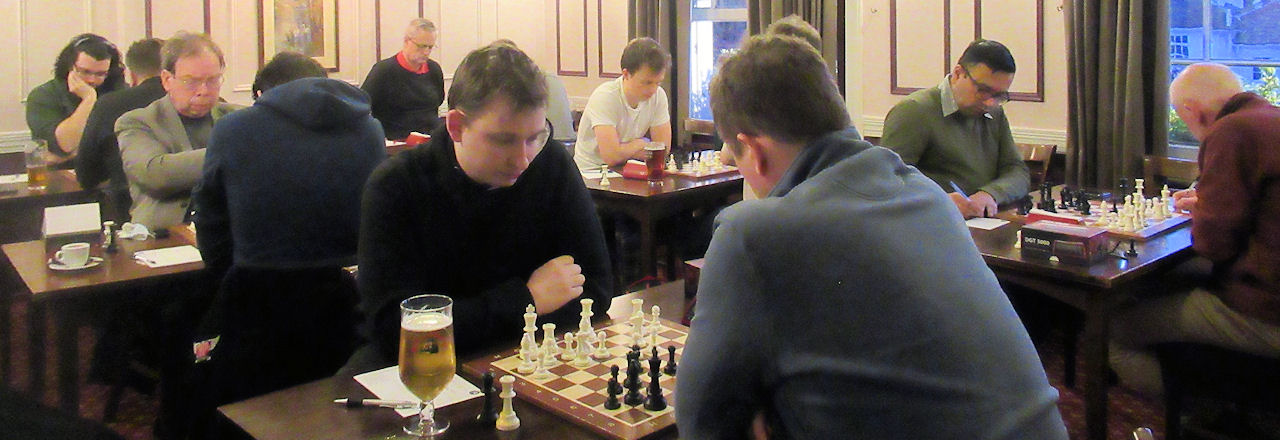
Playing for Richmond B away to Maidenhead B I had, as anticipated, White against Tony Milnes. whom I’d played 10 times previously, the first time in 1980. Our most recent game had been a 12 move draw.
Tony always plays the French Defence against 1. e4 and the Dutch Defence against 1. d4 so I knew what to expect.
1. d4 e6
If you play the French as well as the Dutch this is a good way to start as you avoid dangerous lines like the Staunton Gambit and 2. Bg5. I decided to continue down the main lines for the time being.
2. c4 f5
3. Nf3 Nf6
4. g3 Bb4+
I was again expecting this move, which I often play myself, although he sometimes prefers Be7 here.
This is sometimes called the Dutch Indian, a cross between a Dutch proper and a Nimzo-Indian Defence.
5. Bd2
I don’t want to play Nc3 because the pawn on f5 is useful in the structure with doubled c-pawns. 5. Nd2 is also an option.
5… Qe7
6. Bg2 Bxd2+
7. Nbxd2 d6
8. O-O O-O
So far so normal. Here both players have potential pawn levers. Black is just about to play e5 while White can prepare e4. The engines prefer Re1 (or b4, preparing a potential lever with c5) to my move.
9. Qc2 Nc6
The immediate e5 was also possible, getting in his lever first. Now I could play 10. e4, but over-cautiously wanted to prevent a possible Nb4 first.
10. a3?!
There was no reason not to play 10. e4 as Nb4 is well me by either Qb3 or Qc3. After 10. e4 fxe4 11. Nxe4 Nxe4 12. Qxe4 White is slightly better.
10… e5

A critical moment. My choice here will determine the future course of the game. I could opt for 11. dxe5 dxe5 12. e4 f4 or play d5 to keep the position closed. The computer considers them of equal value and both more than fine for Black.
11. d5 Nd8
I was wondering whether he’d try Nd4 here, but had decided that it wasn’t very good. He agreed, as does the engine. Nd8 is a standard plan for Black in this opening, planning Nf7, which will support a potential g5 with a kingside pawn advance to follow.
12. e3?!
Trying to prevent the pawn lever f4, but again over-cautious. 12. e4 was better.
12… Nf7
13. Nb3?!
Vacating d2 for the other knight. I’d intended to play b4 here, to prepare my pawn lever with c5, but decided it was too slow. Perhaps, but this is worse. The engine gives Black a 1 point advantage after 13… a5. At this point I realised I’d completely misplayed the last few moves. I’ve always found moves 10-15 to be the hardest part of chess, and this game is no exception.
13… b6
14. Nfd2 Bd7
15. Rae1 e4

A critical moment, changing the pawn structure, giving his knight a square on e5 and, at the same time, my knight a square on d4. The engine prefers a5, though.
16. f4
I thought I had to prevent Ne5 followed by Nd3, but in fact 16. Nd4 Ne5 17. f3, meeting Nd3 with Re2, would have been OK for me. Now he can, and perhaps should, take en passant, but preferred to keep the position closed.
16… Nh6?!
I didn’t quite understand this move, which seems to be moving away from the potential pawn lever g5. The eingine doesn’t understand it either, thinking I’m now very slightly better. I still wasn’t very happy with my position, though, as it was hard to see how I could play my pawn lever, c5, without hanging d5.
17. Nd4 Qf7
18. Nb1
Heading for c3
18… Qh5
19. Qe2
Offering a queen trade. I was expecting Tony to play Qxe2 and offer a draw, which I would have accepted. If you know me well you’ll be aware that I’m usually happy to share the point.
19… Qg6
He seemed to think he could attack my king using only pieces. I wasn’t convinced, but still couldn’t see anything concrete for me to do.
20. Nc3 a6
21. b4 Nh5?!
Again I didn’t really understand this, which seemed to leave the knight offside. With the black queen temporarily overloaded (defending e6 as well as h5) I spotted a tactical opportunity. I wasn’t convinced it was going to work but decided to take a punt.

22. Ne6!?
Creative, at least by my standards. The engine isn’t impressed, thinking I should continue woodshifting with a slightly better position, but my move gives Black some tactical problems to solve. When the queenside opens up, his Knights on the Rim will be Dim and Grim, while my pony on c3 (thanks, Mike H) will be a very happy horsey.
22… Bxe6
23. dxe6
Black obviously can’t take this pawn at once, but is it strong or weak? The immediate point is that my knight now has access to d5, with potential forks on e7 or c7 in view.
Now he should grovel with 23… Rfe8 24. Nd5 Rac8, followed by taking on e6. The engine considers the position balanced: I would have enough for the pawn, but no more than that. Instead he played the move I expected.
23… c6?
This is in effect the losing move, leaving Black in a very difficult position.
24. b5!?
The right idea, but even better was 24. Rd1 Rfd8 25. b5!.
24… axb5
25. cxb5 Rxa3

I should really have considered this sequence several moves earlier, and was perhaps lucky to have a good move here. In fact I have two winning moves: 26. Rc1, bringing my rooks into play was also more than good enough.
26. Qc4
Now Black has nothing better than to give up the exchange with Rxc3. But instead…
26… Re8
27. bxc6 Qxe6
28. Qxe6+ Rxe6
29. Nd5 Nf6
Offering a draw: I wasn’t sure why as it’s clear the c-pawn is going through. Not even I would accept a draw in this position! The rest of the game requires no comment.
30. c7 Re8
31. Nxb6 Rc3
32. Rc1 Rxe3
33. c8=Q Rxc8
34. Nxc8 Rd3
35. Rfd1 Nhg4
36. Rxd3 exd3
37. Rd1 Ne4
38. Rxd3 Ngf2
39. Bxe4 fxe4
40. Rxd6 1-0
You can play through the game here: click on any move for a pop-up window.